Ruthimaid Aviation Detailing Academy

- 1 Section
- 1 Lesson
- 1 Quiz
Module 1: Aviation Detailing Industry & Ruthimaid Standards
1 Lesson1 Quiz
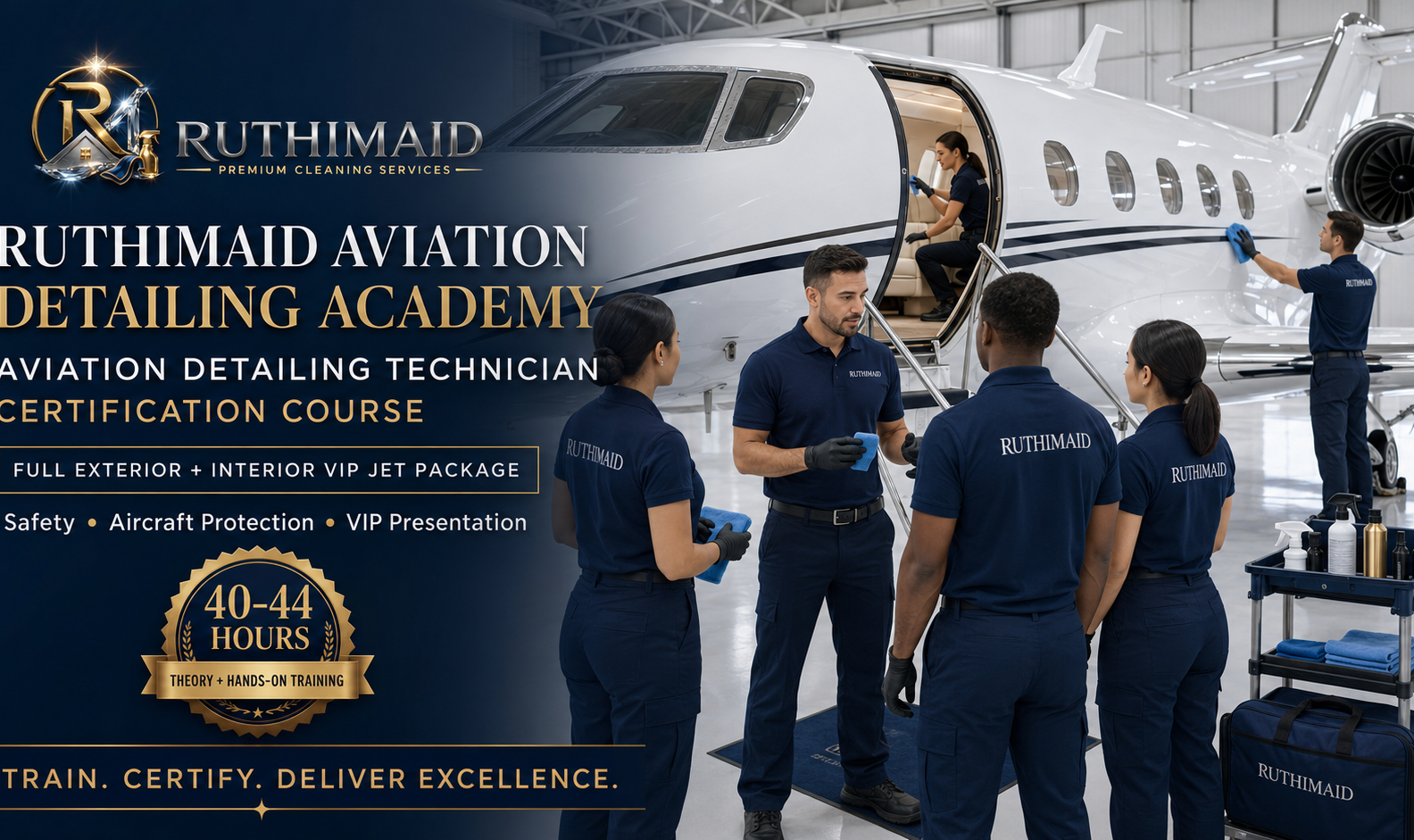
Full Exterior + Interior VIP Jet Package
Recommended course name:
Ruthimaid Certified Aviation Detailing Technician
Private Aircraft & VIP Jet Interior/Exterior Specialist
Course purpose
Train Ruthimaid technicians to clean and detail private aircraft safely while protecting:
- Aircraft paint and polished metals
- Windows and windshields
- Leather, wood veneer and luxury fabrics
- Flight instruments and cockpit controls
- Pitot-static systems, sensors and antennas
- Engines, APUs, vents and other protected openings
- The aircraft owner’s privacy and property
This must be an aircraft-specific certification. A technician should never use a chemical or procedure merely because it is safe for cars, homes or commercial buildings.
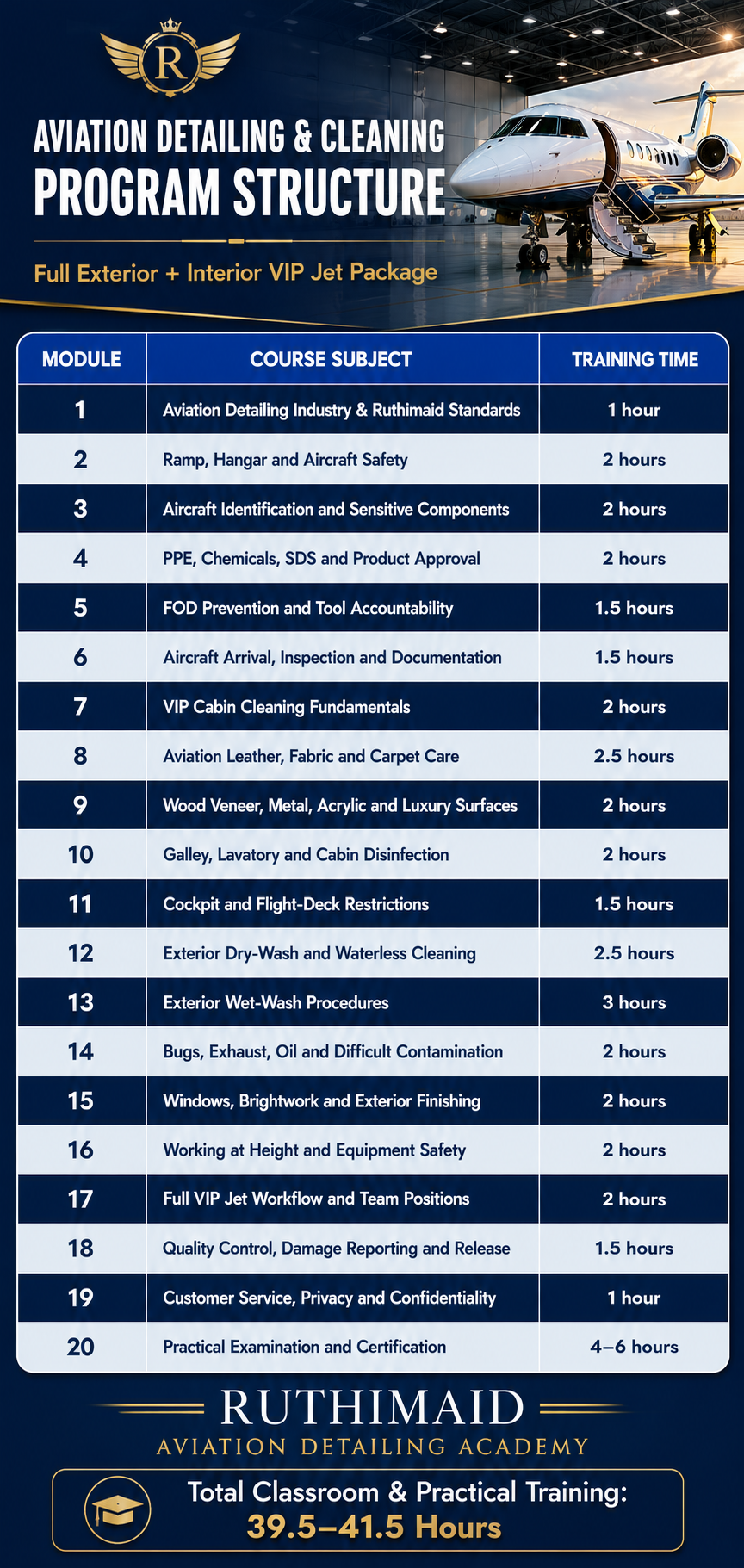
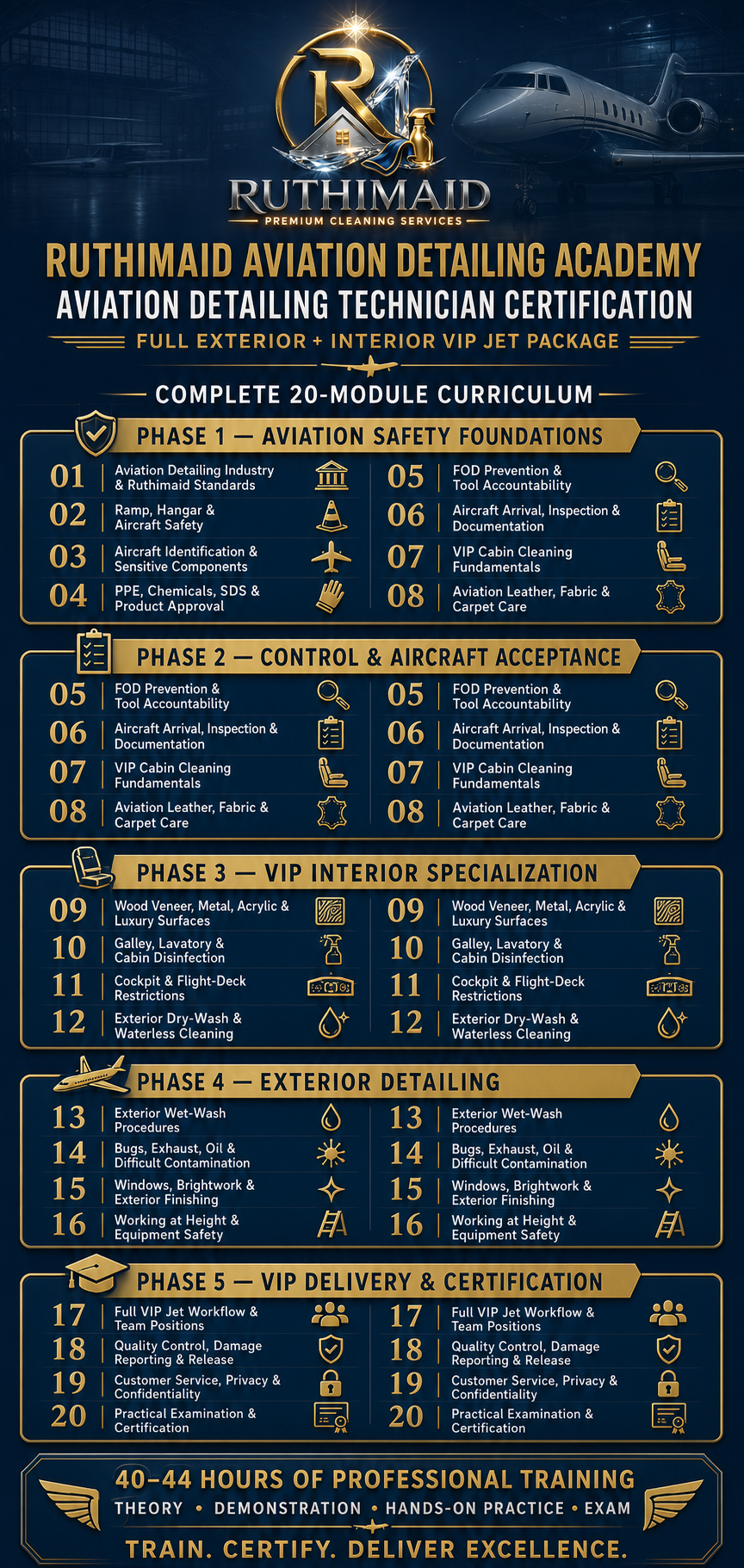
training: 40–44 hours
Certification should require classroom instruction, demonstrations, hands-on practice, written testing and an observed aircraft-detailing assessment.
Technician certification levels
Level 1 — Aviation Cabin Cleaning Technician
Authorized for supervised:
- Cabin vacuuming
- Surface cleaning
- Carpet spot treatment
- Galley and lavatory cleaning
- Amenity presentation
- Approved leather and fabric care
Level 2 — Aviation Exterior Detailing Technician
Authorized for supervised:
- Dry washing
- Wet washing
- Belly and landing-gear-area cleaning
- Bug and exhaust removal
- Window cleaning
- Approved brightwork and paint protection
Level 3 — VIP Aircraft Detailing Specialist
Authorized to complete:
- Luxury cabin restoration
- Advanced leather care
- Carpet extraction when approved
- Exterior finishing and protection
- Final VIP presentation
- Aircraft-specific work-plan execution
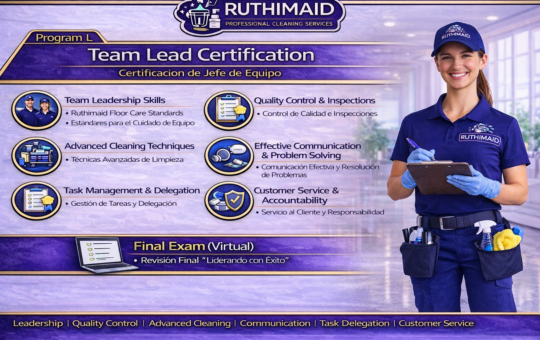
Level 4 — Aviation Detailing Team Lead
Responsible for:
- Aircraft acceptance
- Crew briefing
- Product authorization
- Tool and chemical accountability
- FOD inspection
- Damage documentation
- Final quality-control inspection
- Customer or operator sign-off
A new technician should not work alone on an aircraft merely because the classroom course was completed.
Essential course rules
These should become the non-negotiable Ruthimaid “Aviation Golden Rules”:
- Obtain authorization before touching the aircraft.
- Follow the aircraft manufacturer’s maintenance manual, operator instructions and approved-product list.
- Never spray directly toward instruments, controls, openings or sensitive components.
- Never move switches, circuit breakers, seats, controls or flight-deck equipment without authorization.
- Never cover, uncover, plug or remove anything unless assigned by authorized aircraft personnel.
- Never pressure-wash an aircraft.
- Never stand or place equipment on wings, control surfaces or aircraft structures unless the aircraft instructions expressly permit it.
- Never use household glass cleaner, ammonia, bleach, abrasive pads or unapproved automotive products.
- Every bottle must be labeled; every chemical must have an SDS.
- Every tool and cloth entering the aircraft must leave the aircraft.
- Stop work and report every scratch, crack, loose component, leak, unusual odor or suspected damage.
- Photographs and information about aircraft, passengers, owners and itineraries are confidential.
FAA guidance specifically identifies aircraft ground handling as an activity requiring aircraft- and operator-specific procedures. Its corrosion-control guidance also addresses approved exterior cleaning compounds and surface protection. OSHA requirements relevant to the program include hazard communication, PPE and fall protection. FAA AC 00-34B, FAA AC 43-4B, OSHA airline-industry standards, OSHA fall-protection standard
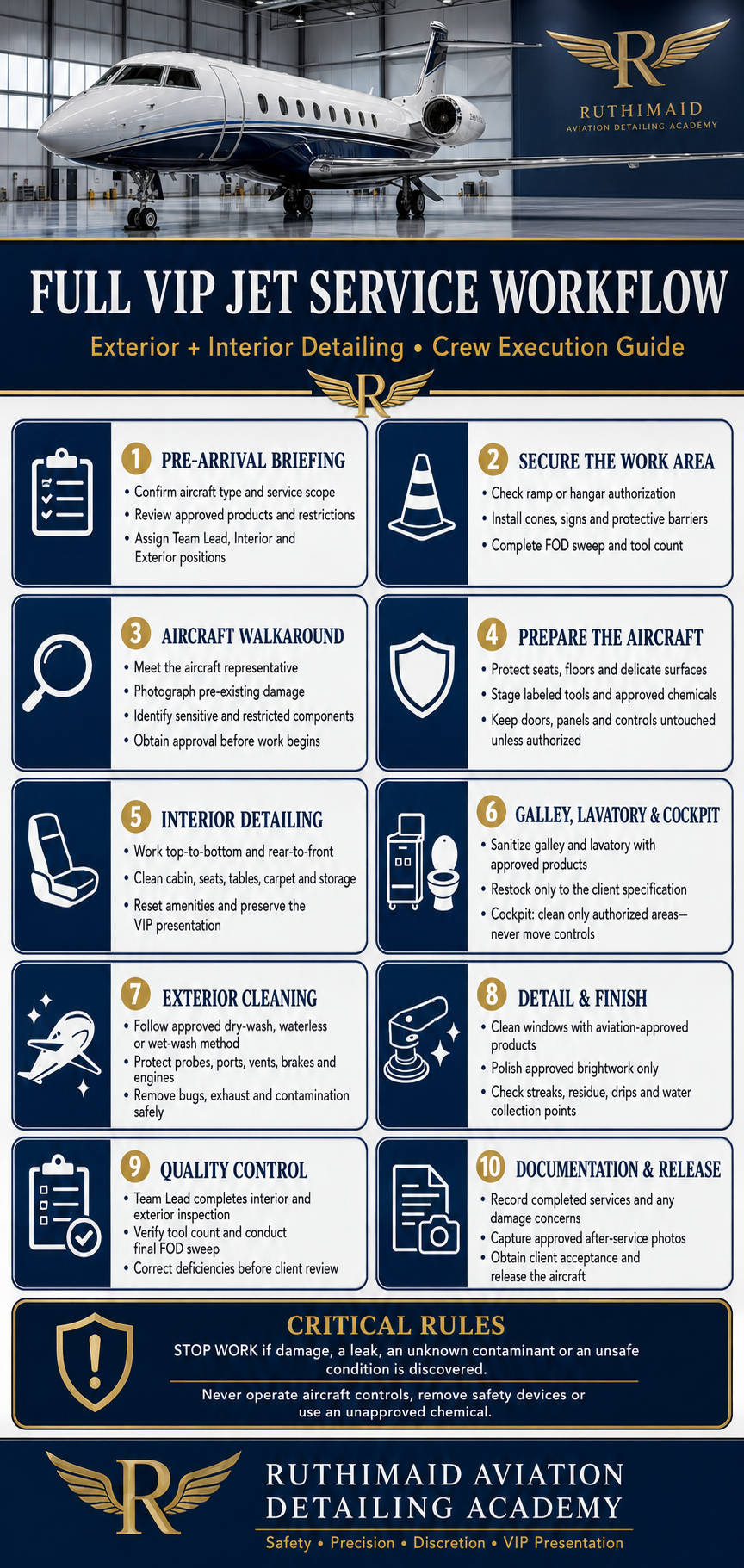
Phase 1 — Aircraft acceptance
The Team Lead verifies:
- Aircraft make, model and registration number
- Operator or authorized representative
- Hangar or ramp work authorization
- Engines and APU confirmed off
- Wheel chocks and safety perimeter handled as directed
- Aircraft-specific prohibited areas
- Approved chemical and process list
- Available electrical and water connections
- Required completion time
- Existing damage and stains
- Photography restrictions
- Key, door and access procedures
- Emergency contact and stop-work authority
Phase 2 — Interior detailing
Recommended sequence:
- Conduct cabin walk-through.
- Photograph and document existing conditions.
- Establish clean tool staging outside the aircraft.
- Remove trash only after confirming what is disposable.
- Secure loose personal property.
- Vacuum from top areas toward the floor.
- Detail ceiling, sidewalls and overhead surfaces.
- Clean passenger seating.
- Clean tables and cabinetry.
- Service galley.
- Service lavatory.
- Spot-clean or extract carpet only when authorized.
- Clean interior windows with an approved acrylic-safe product.
- Detail entry stairs and threshold.
- Reset seats, shades, tables and amenities to operator specifications.
- Conduct final odor, lighting and presentation inspection.
Phase 3 — Exterior detailing
Recommended sequence:
- Confirm protected components and no-spray zones.
- Inspect paint, windows, antennas, seals and existing damage.
- Select the approved dry-wash or wet-wash procedure.
- Work from upper surfaces downward.
- Use separate, color-coded materials for paint, windows, belly and landing-gear areas.
- Remove bugs and contamination without aggressive abrasion.
- Treat exhaust and belly contamination with aircraft-approved products.
- Clean windows using dedicated towels and tools.
- Detail landing-gear surfaces only within Ruthimaid’s authorized scope.
- Apply approved paint protection or polish only when included.
- Remove equipment and protective materials.
- Inspect the work area and aircraft for FOD.
- Report—not attempt to repair—any suspected defect.
Critical protected areas
Technicians must be able to identify these before certification:
- Pitot tubes and static ports
- Angle-of-attack sensors
- Temperature probes
- Antennas
- Static wicks
- Engine inlets and exhaust areas
- APU inlet and exhaust
- Fuel vents and caps
- Drain holes
- Oxygen-service areas
- Emergency exits
- Windshields and acrylic windows
- Deicing boots
- Flight-control surfaces
- Hinges, gaps and seals
- Brake and wheel assemblies
The exact restrictions vary by aircraft. Ruthimaid’s generic SOP cannot replace the aircraft maintenance manual or operator instructions.
Interior surface-care matrix
| Surface | Approved approach | Major prohibitions |
|---|---|---|
| Aviation leather | Vacuum gently; test product; apply to cloth; clean in sections | Saturation, harsh degreasers, household conditioners |
| Alcantara/suede | Low-moisture method and approved soft brush | Aggressive rubbing, soaking, heat |
| Carpet | HEPA vacuum; approved spot treatment; controlled extraction | Overwetting, unapproved fragrance, leaving damp |
| Wood veneer | Soft cloth with operator-approved product | Excess water, silicone-heavy polish, abrasives |
| Acrylic windows | Dedicated clean towels and approved acrylic cleaner | Ammonia, paper towels, dry aggressive rubbing |
| Metal trim | Approved nonabrasive product applied to cloth | Steel wool, uncontrolled metal polish |
| Screens | Dry or manufacturer-approved electronics method | Direct spraying, pressure on display |
| Stone counters | Surface-compatible neutral cleaner | Acidic cleaner without approval |
| Seat belts | Manufacturer/operator-approved method only | Bleach, strong solvent, soaking |
| Cockpit surfaces | Restricted procedure under authorization | Moving controls or spraying panels |
Assessment standard
To receive certification, technicians should achieve:
- Written examination: minimum 85%
- Critical safety questions: 100%
- FOD/tool-control exercise: 100%
- Chemical-identification exercise: minimum 90%
- Observed practical examination: minimum 90%
- No automatic-failure violation
Automatic failures include:
- Using an unapproved product
- Directly spraying cockpit equipment
- Losing a tool inside or near the aircraft
- Stepping on a prohibited aircraft surface
- Ignoring suspected damage
- Bypassing fall protection
- Moving a control or switch without authorization
- Violating customer confidentiality
Recertification
- Annual safety and chemical refresher
- Practical recertification every 12 months
- Aircraft-type briefing before unfamiliar models
- Immediate retraining following a safety violation or damage event
- Documented toolbox talks before unusual or high-risk assignments
Deliverables we should create
I recommend producing the complete program as:
- Instructor manual
- Technician student manual
- Twenty lesson plans
- Twenty educational video scripts
- Module-by-module infographics
- Interior cleaning SOP
- Exterior cleaning SOP
- Cockpit restricted-work SOP
- FOD and tool-control procedure
- Chemical approval register
- Aircraft pre-inspection form
- Existing-damage report
- VIP cabin completion checklist
- Exterior completion checklist
- Incident and damage report
- Written quizzes and final examination
- Practical skills evaluation
- Ruthimaid aviation certificate
Want to submit a review? Login